Wednesday, June 13, 2012

Maastrichtian Foraminifera Working Group


Bolivinoides draco draco
The Foraminifera.eu Working Group "Maastrichtian Foraminifera" has started to operate.

A Maastrichtian sample from a core-drill from Hemmoor, Northern Germany has been processed. Stefan Raveling who provided the sample did also the washing, sieving and optical imaging. SEM-imaging was done by Dr. Rosenfeldt and Michael Hesemann.

First 60 images are online at www.foraminifera.eu/hemmoor.php The material is corroded but still shows important details and ornamentation to identify single specimens.

The Working Group "Maastrichtian Foraminifera" will continue to work on this sample, samples from the Laegerdorf Quarry, also Northern Germany and from a drill-core from the Baltic Sea. Other Maastrichtian material is welcome and the group is open for more members. In case of interest you may contact us via email: michael [at] foraminifera.eu

It is planned to meet in November 2012 on a Saturday in Hamburg, Germany to discuss the project and single species. The results will be used for the related "Index Foraminifera Cretaceous" Project.


Ramulina wrightii

Thursday, May 3, 2012

5000 images online


On the 1st of May 2012 we added the 5000th image
to the Foraminifera.eu Database.


To find the images you are looking for we created our database-query. It allows to choose from a set of criteria in classification, locality, geological time + others.


To create the poster I chose "Elphidium" to see all the images we have.


Please consider to contribute your images and get your own web-pages within foraminifera.eu. See for example: www.foraminifera.eu/tichenor.php

Thursday, April 19, 2012

Upper Cretaceous of the United States


As the number of foraminiferal images increases a new interface for their access is needed. The generalized map of the United States at Upper Cretaceous time - seen above - illustrates the localities, where the samples are from. Moving the mouse over the circles reveals the locality and a click brings you to the illustrations of its forams.

The stratigraphical chart - seen below - illustrates the stratigraphical setting and from which formation the samples are. A click on the coloured areas brings you to the illustrations of its forams.

Do you like this new features and what do you think, should be done better ?


Link to the full page
and its internal links


Wednesday, March 14, 2012

Paleozoic Foraminifera - 350 million years old


Dr. James E. Conkin and Prof. Barbara M. Conkin gave us specimens and images of Paleozoic foraminifera. Now we integrated some of their images of 350 Mio. year old foraminifera from the Lower Mississippian of Missouri and Illinois, USA. It is planned to work on more Paleozoic foraminifera, though the forms are primitive and not that beautiful as modern ones.

We are very grateful to Michael Popp running the Louisville Fossil Blog who arranged this valuable contact to the Conkins.

Thursday, February 2, 2012

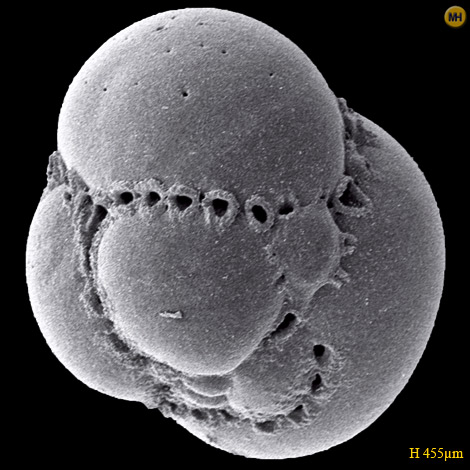
Candeina nitida - a unique planktonic foraminifera


Candeina nitida
Candeina nitida d'Orbigny, 1839 is a unique and easy recognizable planktonic foraminifera. Its umbiliculus is covered resulting in a globose appearance. Along the last sutures rows of pores are placed, which commonly have a marked rim.

It is reported in the fossil record from Earliest Pliocene till recent. It thus allows to distinguish older from younger sediments, namely Miocene from Pliocene.

The specimens shown were found 1815m deep in the Puerto Rico Trench. The tests sank to the bottom as Candeina nitida d'Orbigny 1839 lives in the upper parts of the ocean.

Find more images
here


Candeina nitida

Monday, January 9, 2012

Newsletter 2011/2012


The Newsletter 2011/2012 is out. It comprises seven rich illustrated pages. Read what has been achieved in 2011 and what is planned for 2012.

To get it as PDF please write to michael [at] foraminifera.eu

Michael


Sunday, December 11, 2011

579 Forams from Greece on a single slide

The huge foram collection of coworker Karl-Otto Bock is housed in single plummercell-slides, where forams are neatly arranged in single fields. We have started to put his collection online with this plummercell slide. It is filled primarily with miliolid specimens found at the beach of Malia on Crete - a Greece island. The single fields are clickable and are integrated into the foraminifera.eu database.


To see more follow the link and click on the single fields of the

Plummercell slide from Malia, Crete

.