Showing posts with label d'orbigny. Show all posts

Monday, November 18, 2013

Miocene Foraminifera - hundreds of images added


A mayor work on Miocene Foraminifera is the revision of D'Orbignys "The Fossil Foraminifera of the Tertiary Basin of Vienna". Its hundreds of SEM images are now integrated in our database courtesy of the Geological Survey of Austria at

Cheers Michael
 

Thursday, February 2, 2012

Candeina nitida - a unique planktonic foraminifera


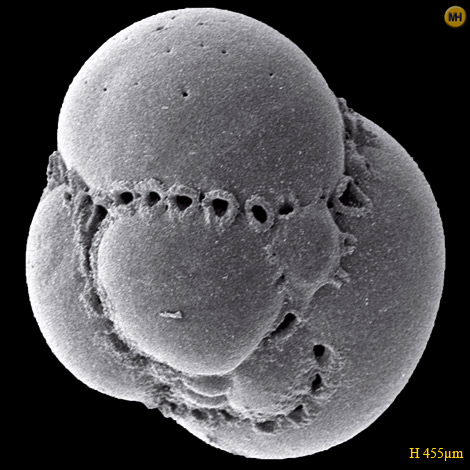
Candeina nitida
Candeina nitida d'Orbigny, 1839 is a unique and easy recognizable planktonic foraminifera. Its umbiliculus is covered resulting in a globose appearance. Along the last sutures rows of pores are placed, which commonly have a marked rim.

It is reported in the fossil record from Earliest Pliocene till recent. It thus allows to distinguish older from younger sediments, namely Miocene from Pliocene.

The specimens shown were found 1815m deep in the Puerto Rico Trench. The tests sank to the bottom as Candeina nitida d'Orbigny 1839 lives in the upper parts of the ocean.

Find more images
here


Candeina nitida

Tuesday, August 10, 2010

Globorotalia truncatulinoides


Globorotalia truncatulinoides (d'Orbigny, 1839) is a planktic foraminifera.

It tolerates a broad range of sea surface temperatures and salinities and occurs in subtropical and transitional water masses. It is a deep-dwelling species which ascends to shallower depths during its reproduction period in winter. In the fossil record it is since the Pleistocene and may be used for studies on climate change of the last 2 mya.

The relative abundance of dextral coiling is higher at lower latitudes.

The specimens shown here are from a sample from the Hebridian Slope off Scotland in the North Atlantic. Northwest of the British Isles, this steep continental slope to depths greater than 2000 m separates the distinct continental shelf of Europe from the deeper Atlantic Ocean. The sample is in the repository of the Scottish Association for Marine Sciences, Oban.

see more foraminifera found at the Hebridian Slope


Umbilical view of a
dextral coiling specimen


Spiral View


more images of Globorotalia truncatulinoides at
Laboratório de Microfósseis Calcários,
Rio Grande do Sul, Brasil

Tuesday, June 15, 2010

Classical Site: Damery - Fleury-la-Rivière

A classical site for (micro-) paleontological research is the area Damery - Fleury-la-Rivière in the Paris Basin. It is famous for rich fossil beds of Lutetian Age (48.6 - 40.4 mya). In the 19th century pre-evolutionist Jean-Baptiste Lamarck (1744-1829), the author of many first descriptions of species Alcide Dessalines d'Orbigny, Olry Terquem (1797-1886) and others worked on fossil foraminifera of the Paris Basin.

The foraminiferal fauna indicates shallow water, warm marine conditions such as found today in the Red Sea: a great variety, rich ornamented and big foraminifera, a substantial part being Miliolids.


Ornamented Miliolid: Miliola prisca (Terquem, 1882)


Unornamented, rather large Miliolid: Triloculina trigonula (Lamarck, 1804)


Trochulina turbo (d'Orbigny, 1826), umbilical side


Trochulina turbo (d'Orbigny, 1826), spiral side


See more images on Fleury-la-Rivière

The sediment-sample was sent by Adrian, Thanks a lot !